Vegetable Chowder by Sanjana Lahiri
This project is premised on companion planting, an idea that originated from the Indigenous Iroquois group. The Iroquois story of the Three Sisters spoke of how certain plants could be grown together to create a micro-ecosystem for mutual benefit. The first drawing depicts five plants grown using the companion method that form the ingredients to my dish: a vegetable chowder. The corn provides structure for the beans to grow, while the beans capture nitrogen from the air and release it into the soil for the other plants. Fallen leaves from the corn become green fertilizer for the potatoes. The potatoes repel the Mexican bean beetle, while the beans repel the Colorado potato beetle. Both the chives and the cilantro attract beneficial pollinators into the system. The corn, chives, cilantro, and beans have shallow root systems that don’t interfere with the growth of the potatoes. The second drawing shows the set-up for my dish, which is intended to be cooked as the ingredients are harvested. Edible stems and leaves are boiled to create vegetable stock. Potatoes, then beans, and subsequently herbs, are added to complete the soup. The dish employs the tools of the garden, the tools of the kitchen, and those of dining.
Synthetic Still-Lifes by Foivos Geralis
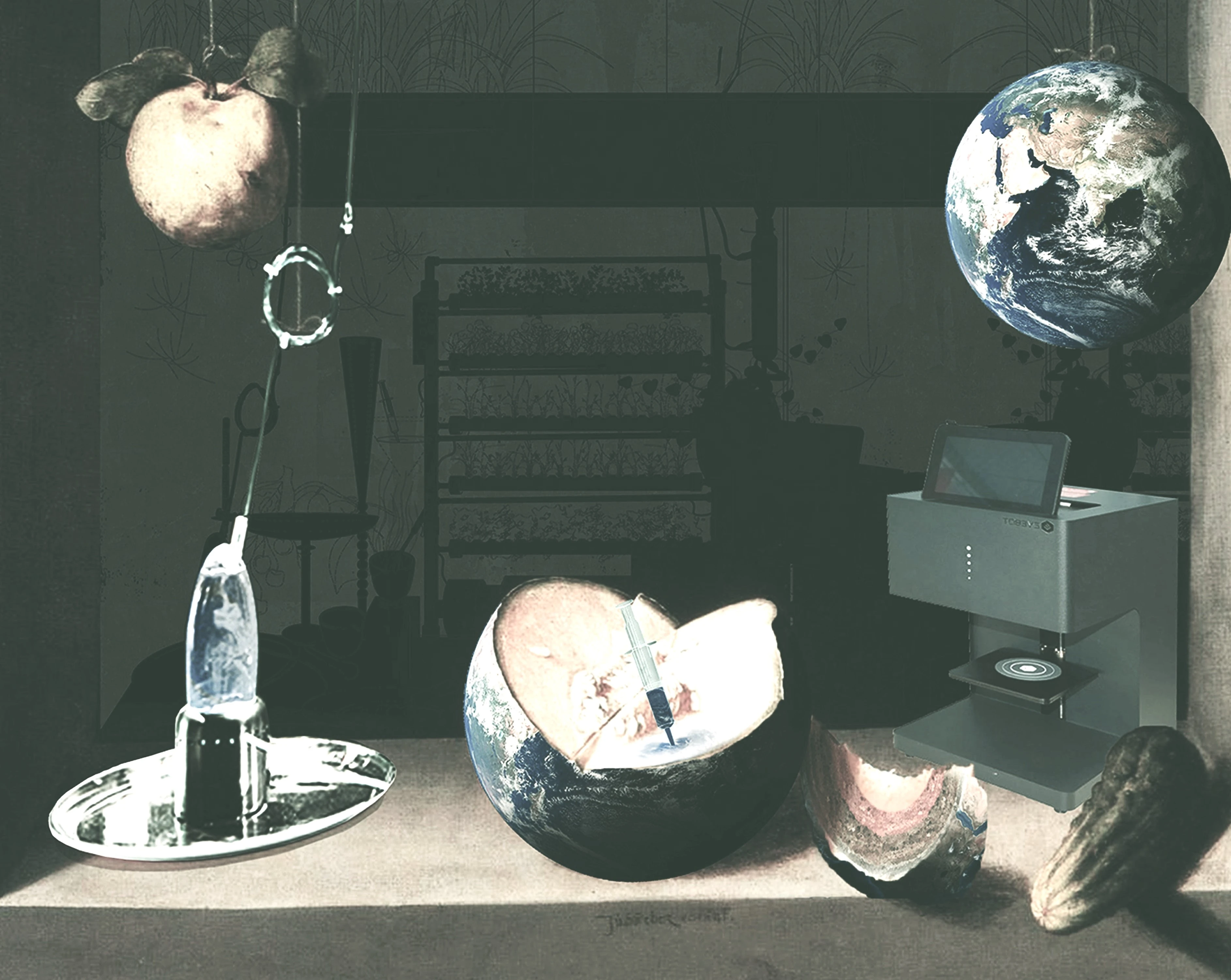
Since the early stages of western capitalism, food was associated with notions of territorial sovereignty, as depicted in Baroque still-life paintings, where excessive food compositions coexist with cartographies and models of globes. This coexistence reveals the artificiality of still-lifes as assembled food landscapes: collections of plants, fruits, lavish meat and sea-food, all from different seasons, environments and places of the world. At the intersection of the English term ‘still-life’, and the French ‘nature morte’ [dead nature] these paintings reveal the tense relation between the euphoric accumulation of extravagant food and capital, and the vanitas of withered leftovers, eloquent reminders of an inevitable gloomy future.
Today, similar synthetic and transglobal assemblages of collected elements can be found wherever food is sold. 18th and 19th-century selective cross-breeding of plants and cultivation technologies exponentially led to today’s hydroponics stacks, technologically-controlled environments, GMOs and new forms of food directly 3dprinted or grown in petri-dishes. Food exists now regardless of restrictions of place, climate or season.
By reconfiguring baroque still-lifes with contemporary iconography of food, cultivation environments (hydroponics, UV lighting, 3d-printers) and cartographic models, these drawings aim to bring into question the diachronic relation of the artificiality of food accumulation and its geopolitics, as well as the continuous processes of hybridization of food throughout the last centuries.